

The Setup: More Than Meat on the Bone
In his recent Mises Wire article, “When a Chicken Isn’t Just a Chicken,” Patrick J. Lee makes a deceptively simple claim: a chicken is not “just” a chicken. Behind that statement lies a broader Austrian insight—goods are not defined merely by their physical properties, but by how human beings perceive, value, and use them.
Given that I am a gentleman farmer currently with 11 chickens that produce 10-11 eggs per day, Lee’s title caught my eye. Although Lee focused on a source of meat, a chicken can be:
1. A future stream of eggs (in my case, you gain many new friends)
2. A source of meat
3. A breeding asset
4. A cultural or even symbolic good
Its economic identity shifts based on human intention.
This is classic Austrian economics: value is subjective, rooted in individual preferences, expectations, and purposes. There is no intrinsic “economic essence” embedded in the chicken itself.
That’s a helpful correction to sterile, purely mechanistic models of economics. But it’s also not the whole story.
Where Austrian Economics Gets It Right
Lee’s argument presses on a real weakness in modern economic thinking—namely, the tendency toward reductionism.
In many models:
· Goods are treated as homogeneous units
· Preferences are assumed rather than examined
· Meaning is stripped away in favor of mathematical tractability
Austrian economics resists this by emphasizing:
1. Purpose shapes value A chicken is not a fixed economic object. It becomes what the actor intends.
2. Time matters A chicken today is different from a chicken tomorrow—because expectations about eggs, growth, or consumption evolve.
3. Knowledge is dispersed No central planner can fully grasp the range of meanings attached to a simple good.
These are important insights—and, interestingly, they resonate with a biblical view of human action as purposeful rather than mechanical.
Where It Stops Short: The Missing Ontology
Here is where the analysis needs sharpening. Austrian economics tells us that value is subjective. But it does not tell us whether all subjective valuations are equally valid.
And that’s a problem. If a chicken can be:
· Food
· A productive asset
· A status symbol
· An idol
Are all these uses equally “economic”? Technically, yes—within Austrian logic. But biblically, no.
A Biblical Economic Framework: Objective Order, Subjective Stewardship
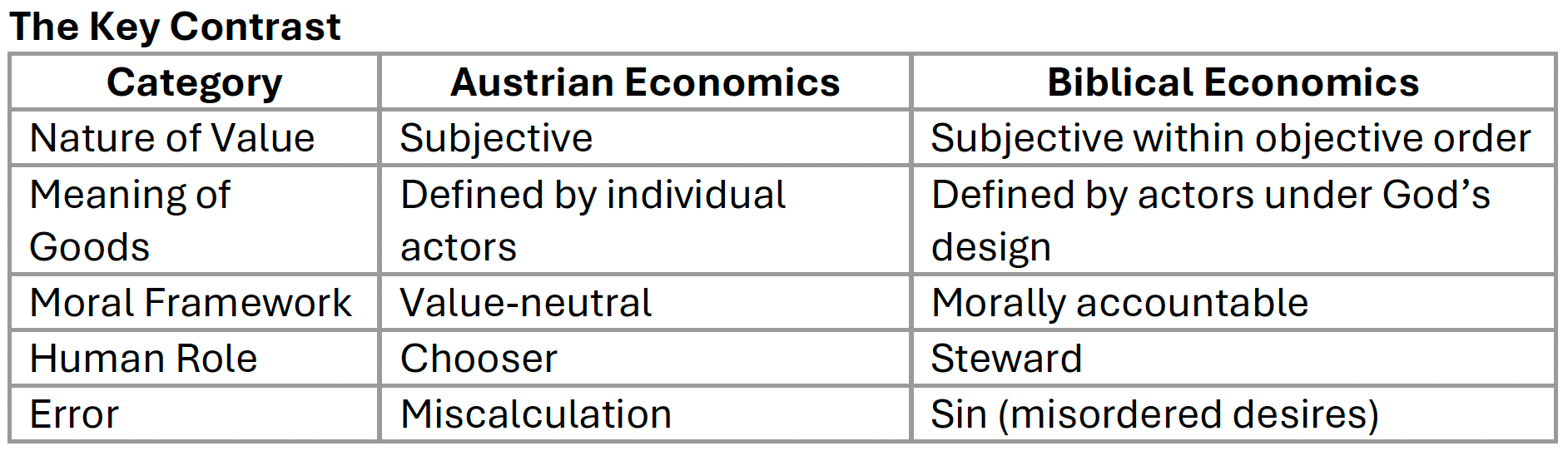
The Bible affirms something Austrian economics only partially captures: Humans assign value—but within a world already ordered by God.
Consider three layers:
1. Created Order (Objective Reality)
In Genesis 1, God creates a world with structure, purpose, and hierarchy. A chicken is not infinitely malleable in meaning. It is:
· A living creature
· Part of a created ecosystem
· Given for human use (Genesis 9:3), but not abuse
There is an objective structure beneath subjective valuation.
2. Human Purpose (Subjective Intent)
Here Austrian economics shines. Humans:
· Form expectations
· Make plans
· Assign value based on goals
This aligns with the biblical concept of humans as image-bearers—agents who act intentionally.
But Scripture also warns: “The way of a fool is right in his own eyes…” — Proverbs 12:15
Subjective valuation is real—but not always right.
3. Moral Evaluation (Covenantal Accountability)
This is where the biblical framework goes beyond Austrian economics. Not all uses of a chicken are morally neutral.
· Using it to feed a family → good stewardship
· Using it wastefully → poor stewardship
· Idolizing it (Ephesians 5:5 principle applied broadly) → disordered worship
Economic action is not just about preference satisfaction—it is about faithful stewardship under God.
The Hidden Danger: Infinite Flexibility
Lee’s insight—that a chicken can be many things—contains a subtle risk. If meaning is entirely fluid, then:
· Nothing has inherent purpose
· Everything becomes a projection of human desire
This is where Austrian economics can unintentionally drift toward the same philosophical territory as naturalism:
· No fixed ends
· No ultimate telos
· Only shifting preferences
But Scripture insists otherwise. Creation is not infinitely plastic. It is ordered, purposeful, and accountable.
A More Complete View: The Chicken as a Test Case
Let’s bring it down to earth. A chicken is:
Economically:
· A capital asset (egg production)
· A consumption good (meat)
· A store of value (breeding potential)
Biblically:
· A created good under human stewardship
· A provision from God
· A resource to be used wisely, not worshiped or wasted
The difference is subtle but profound: Austrian economics explains how we value the chicken. Scripture explains how we ought to value it.
Implications for Modern Finance
This is not just about poultry. Replace “chicken” with:
· Stocks
· Real estate
· Private equity
· Cryptocurrency
And the same issue emerges. Modern finance often operates as if:
· Value = price
· Preference = justification
But a biblical framework asks:
· Is this use aligned with God’s purposes?
· Does it promote stewardship or excess?
· Does it build or distort culture?
This is particularly relevant for Biblically Responsible Investing (BRI). A purely Austrian lens might say: “If investors value it, it has value.” A biblical lens asks: “Should it be valued that way?”
Final Thought: The Limits of “Just”
Lee is right to reject the phrase “just a chicken.” But the deeper correction is this: Nothing in God’s world is “just” anything.
· Not capital
· Not labor
· Not markets
· Not wealth
Everything carries:
· Purpose
· Structure
· Moral weight
A chicken is not just a chicken. But neither is it whatever we want it to be. It is a created good—entrusted to human beings who are not merely valuers, but stewards. And that changes everything.
After all, when eleven of them greet you each morning—transforming feed and other compost into breakfast with quiet, feathered precision—it’s hard not to see that a chicken isn’t just an asset, but a small, clucking testament to the creative abundance of God.
Great stuff here.