

When evaluating equity mutual funds and exchange traded funds (ETFs), expense ratios—the annual fees taken out of fund assets—are among the most scrutinized metrics. Biblically Responsible Investor (BRI) funds are no exception. Expressed as a percentage, they encompass all ongoing operational costs, including management, administration, 12b‑1 (marketing/distribution), custodial, legal, and auditing expenses. When serving as the Chief Investment Officer of a small ETF shop, I was shocked to learn of the numerous entities and their fees required to run it. In general, actively managed equity funds carry higher expense ratios than passive or index‑based counterparts, reflecting elevated research and trading costs.
Notably, expense ratios have declined over time: for equity mutual funds, average expense ratios dropped roughly 62% from 1996 to 2024. This underscores the relevance of cost to investors’ long-term returns.
Empirical Evidence: Higher Expense Ratios, Lower Net Holding Period Returns
A long-established conclusion in academic finance is that higher expense ratios are negatively associated with net-of-fees performance, especially after adjusting for risk factors. More recent empirical work affirms that on average, funds with higher expenses underperform those with lower fees when looking at net-of-cost, factor-adjusted returns.
Morningstar-based decile analyses further show no clear positive trend in performance across expense deciles. For instance, funds across the bottom 90% of expense ratio deciles display alphas (via Capital Asset Pricing Model) ranging from modestly negative to around +0.87%, with no consistent advantage for lower-cost funds.
The literature in summary paints a clear picture:
On average, higher expense ratios correspond with lower net performance.
For most investors, expenses are a significant drag over time—models show even a 1% annual expense can shave off tens or hundreds of thousands of dollars in long-run wealth.
Significant fund fees that result in decremented fund performance clashes with a biblical view of fair dealing, especially because it is difficult for the typical investor to understand.
Biblical View Regarding Fair Dealing
Fair dealing in financial markets flows from the broader biblical ethic of honesty, justice, and love for neighbor, interpreted through the lens of God’s law and the gospel. The following issues are briefly explored, God’s moral law, just weights and measures, love of neighbor, and the stewardship mandate.
Fair Dealing is Rooted in God’s Moral Law
God’s moral law—summarized in the Ten Commandments—remains binding in its moral requirements for all people. Fair dealing in finance especially draws on:
· The Eighth Commandment – “You shall not steal” (Exodus 20:15) forbids taking what belongs to others by fraud, coercion, or deceit. In markets, that includes insider trading, market manipulation, false disclosure, and misrepresentation of products or risks.
· The Ninth Commandment – “You shall not bear false witness” (Exodus 20:16) requires truthfulness in communication—accurate reporting of financial results, truthful marketing, and transparent disclosures.
· The Tenth Commandment – “You shall not covet” (Exodus 20:17) warns against greed and envy, which often fuel unethical market practices.
The Biblical Principle of Just Weights and Measures
Scripture repeatedly insists on honest standards in commerce:
· “You shall do no wrong in judgment, in measures of length or weight or quantity. You shall have just balances, just weights…” (Leviticus. 19:35–36)
· “A false balance is an abomination to the LORD, but a just weight is his delight.” (Proverbs 11:1)
In market terms, “just weights” means fair pricing, accurate valuation, and the absence of hidden costs or misleading terms. In modern financial instruments, that can include transparent risk disclosure and the avoidance of complex structuring designed to obscure true cost or risk.
Love for Neighbor in Economic Exchange
All business dealings are viewed through Christ’s summary of the law:
· “You shall love your neighbor as yourself.” (Matthew 22:39)
· This is not sentimentality but a covenantal obligation: one must not seek gain at another’s unjust loss (cf. Philippians 2:4). In markets, love for neighbor means:
o Structuring contracts that are mutually beneficial, not exploitative.
o Avoiding predatory investment schemes.
o Considering the long-term well-being of clients, counterparties, and even competitors.
The Stewardship Mandate
From Genesis 1:28 and the parable of the talents (Matthew 25:14–30), Christians must view market participation as part of our stewardship of God’s resources. Fair dealing is a stewardship issue because:
· Wealth is ultimately God’s (Psalm 24:1); we are managers, not owners in the absolute sense.
· Stewardship is measured not only by return but by faithfulness—how wealth is gained matters as much as how much is gained.
Rejecting Pragmatic Utilitarianism
Therefore, biblical theology resists the idea that “if it’s legal and profitable, it’s acceptable.” God’s standard is higher than civil regulation. Profit achieved through deception, manipulation, or unjust advantage is sin, even if the law allows it.
Practical Implications in Financial Markets
From this theological grounding, the Christian approach to fair dealing should consider:
· Transparency in financial disclosures.
· Honesty in marketing and client communications.
· Avoidance of conflicts of interest (or full disclosure when unavoidable).
· Rejection of market manipulation in any form.
· Equitable treatment of all involved, including small investors.
· Refusal to exploit information asymmetries in a way that defrauds others.
Witness to the Gospel
Because markets are public spheres, the Christian’s conduct in finance can either adorn or tarnish the gospel (Titus 2:10). Fair dealing is not merely a moral duty but also a missional witness: showing that Christ rules over our economic life as surely as over our worship life.
Therefore, a BRI fund expenses should be viewed in the context of fair dealing. In financial markets, it is founded on our covenantal relationship with God and being Christ-centered: the believer’s market activity must reflect God’s holiness, obey His moral law, serve neighbor’s good, and steward God’s resources faithfully. Profit is not rejected—but it must be pursued through honest, transparent, and just means that reflect the character of the God who owns all wealth.
How Do BRI Funds Perform?
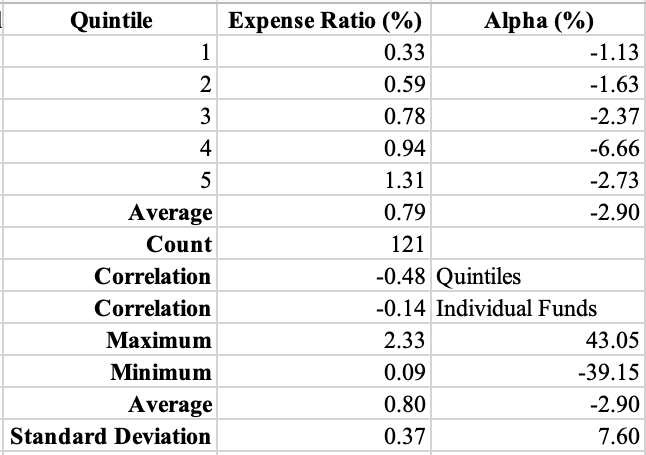
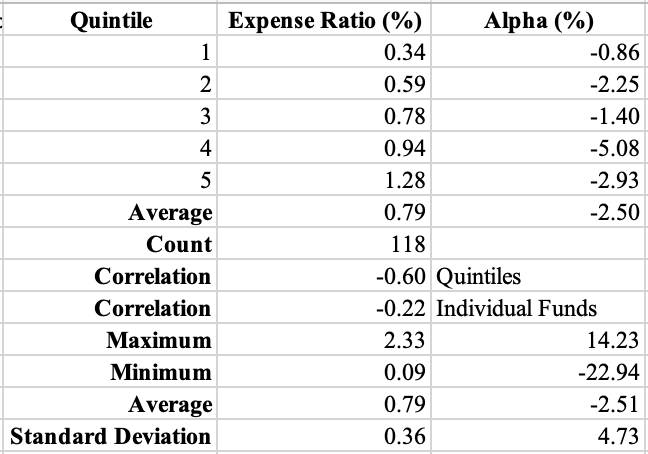
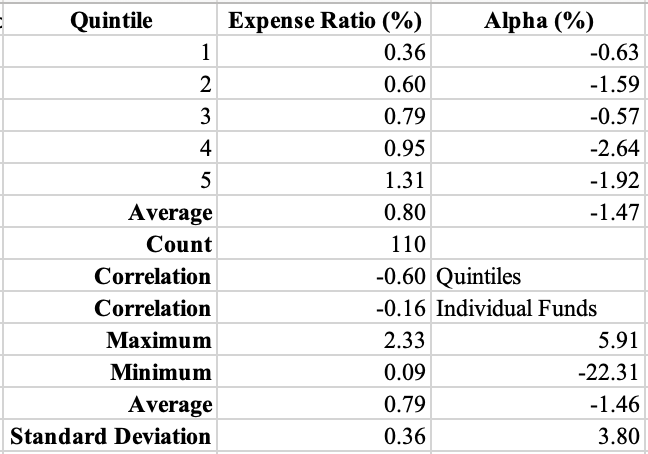
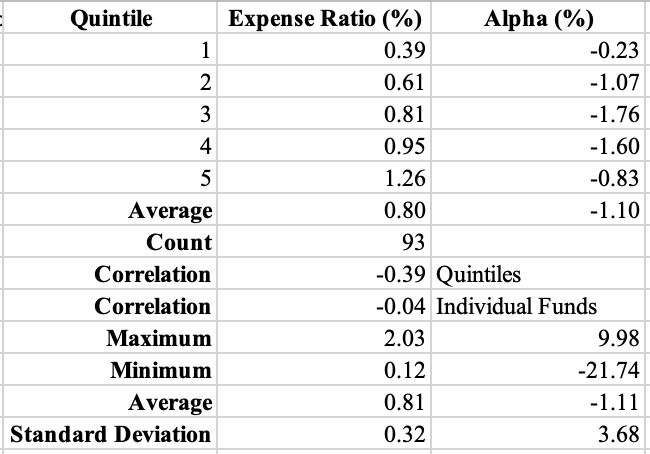
The following tables and figures show aggregate BRI fund performance based on expense ratio quintile. The expense ratio used for mutual funds is the institutional class, thus smaller clients pay even more. The expense ratios are from the last quarter’s fact sheets, not the beginning of the holding periods. Most likely, these expense ratios have not changed dramatically. Longer holding periods have fewer funds reflecting the launch of new funds over this period. Alpha measures the annualized (arithmetic) average return of the fund when compared with the selected benchmark for that fund. Although not monotonic, the pattern is clear: The higher the expense ratio, the lower the alpha.
One Year Holding Period (8/13/24-8/13/25)
Two Year Holding Period (8/13/23-8/13/25)
Three Year Holding Period (8/13/22-8/13/25)
Four Year Holding Period (8/13/21-8/13/25)
Five Year Holding Period (8/13/20-8/13/25)
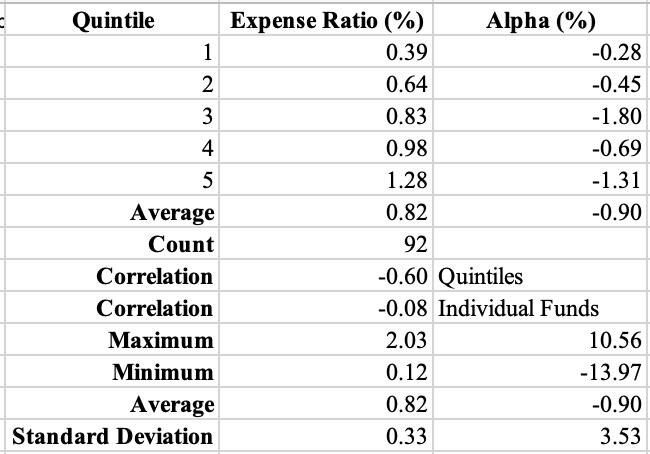
Conclusion: We focus here on only two insights that can be gleaned from this evidence. First, like the academic evidence presented above, the BRI funds exhibit the same pattern of higher expense ratio funds having lower alpha on average. The quintile correlations range from–0.60 to –0.39 and the fund correlations range from –0.22 to –0.04. Thus, the BRI community should make a concerted effort to lower fees. Second, the BRI funds underperform their benchmark just like other funds (see SPIVA reports) suggesting the BRI community may pursue more passive indexed but BRI consistent strategies (an interesting application of this pursuit can be seen in PTL, an Inspire Investing product).