

In the 09-02-2025 article, I argue that higher expense ratio actively managed BRI funds have lower alpha (underperformance relative to their appropriate benchmark). In the 09-16-2025 article, I further argue that tracking error volatility is highly correlated with expense ratios providing the channel for tying underperformance to active management (and high fees). In the 09-30-2025 article, I make a call for the BRI fund industry to create a “Virtuous Forerunner”—a family of BRI funds with razor-thin fees and broad diversification but aligned with biblical values.
Twice each year, Standard & Poor’s releases something like the “truth serum” of the investment world—the SPIVA U.S. Scorecard. SPIVA (S&P Index Versus Active) is the long-running, data-driven assessment of how active managers perform relative to their benchmarks. It is famous for one recurring headline: most active managers underperform.
But every report has nuance, and the latest SPIVA update is no exception. For those of us watching the emerging world of Biblically Responsible Investing (BRI) public funds—whether index-based or actively managed—SPIVA offers more than an academic curiosity. It provides a sobering (and encouraging) set of facts that can shape product design, investor expectations, stewardship standards, and long-term portfolio strategy.
Let’s walk through what SPIVA is saying now—and what it means for the BRI ecosystem.
The State of Active Management: SPIVA’s Consistent Signal
If you have followed SPIVA for any length of time, you already know the story arc. But the most recent U.S. Scorecard sharpens several themes:
Across most categories, the vast majority of active managers underperform.
For the All Domestic Funds category:
1. 1-Year: 80% of managers underperform the comparison index.
2. 5-Year: 91% of managers underperform the comparison index.
3. 10-Year: 90% of managers underperform the comparison index.
4. 20-Year: 95% of managers underperform the comparison index.
The further you extend time, the harsher the scoreboard becomes. Compounding works both ways—beneficial for investors, harmful for persistent underperformers. Given the lengthening life- and health-spans, 20 years could be viewed as short term.
Mid-cap and small-cap active managers show slightly better (but still discouraging) performance
Some mid-cap categories occasionally see 50% or more of funds beating their benchmarks in a given year, but persistence is still sparse. For example, for year-end 2025, All Small-Cap Funds, 1-Year 41% and 3-Year 42% of managers underperform the comparison index, respectively
Persistence remains the Achilles’ heel
Managers who outperform in one period rarely remain in the top quartile in the next. If consistent outperformance is the gold standard, SPIVA’s persistence studies show it is scarcer than hen’s teeth.
Survivorship bias remains substantial
Across 10+ year periods, 40–60% of funds disappear due to mergers or liquidations. Many of the worst performers simply vanish from the database—meaning real-world investors often ended up in funds that no longer exist.
If SPIVA were a sermon, its recurring message would be: “Active management is hard. Really hard.”
Relevance for the BRI Market: The Playing Field Is Smaller, but the Mathematics Are the Same
The BRI space is a niche within the broader mutual fund and ETF universe, but investors in this space are not exempt from the structural realities SPIVA reveals.
BRI funds—whether passive or active—face the same competitive forces that drive SPIVA’s results:
1. Market efficiency: U.S. markets incorporate information rapidly.
2. Fees matter: Higher expense ratios mean a higher hurdle before outperformance.
3. Behavioral pitfalls: Managers are human. And the Bible has an entire anthology on human nature.
4. Benchmark discipline: Deviating from an index can add value—or destroy it.
The crucial insight is this: BRI funds are not immune from the physics of markets. Faithful stewardship calls for sober evaluation, not sentimental optimism.
Implication #1: BRI Investors Should Prefer Low Cost Index-Based Funds
Many BRI funds are structured as active equity strategies, sometimes with expense ratios between 0.60% and 1.00% (or unfortunately even higher). SPIVA shows how difficult it is for any active manager—faith-based or not—to overcome those fee hurdles over long horizons.
This does not mean active BRI funds cannot succeed. Perhaps some will. But SPIVA gives us two criteria:
A. Does the manager have a repeatable, disciplined investment process?
BRI managers sometimes emphasize moral screening as their differentiator. But values alignment does not automatically produce financial alpha.
A successful BRI active fund must show:
· Clear factor exposures that are biblically aligned
· Disciplined and cost efficient portfolio construction
· Risk controls that match mandate
B. Is the fee structure competitive relative to expected excess returns?
If SPIVA tells us 5–10% of active managers outperform over 15 years, paying above-market fees for unsystematic approaches becomes difficult to justify.
Implication #2: Passive BRI Index Funds Have a Structural Tailwind—If Their Screens Are Sensible
A growing subset of BRI vehicles uses index approaches—often mirroring broad-market exposures but applying Christian ethical screens (for example, abortion, pornography, gambling, etc.).
SPIVA’s results strongly favor such strategies because:
· Lower fees = higher net returns
· Broad diversification reduces idiosyncratic risk
· Systematic exposure tends to approximate market returns
One must, however, evaluate the screening methodology carefully. A poorly designed BRI index can unintentionally:
· Overweight narrow industries
· Increase volatility
· Create uncompensated risk exposures
Implication #3: Resist the Narrative That “Christian Values = Outperformance”
Some BRI marketing materials imply (or state outright) that morally screened portfolios should outperform because companies aligned with biblical ethics are better stewards, more sustainable, or less prone to scandal.
While that may be true in some cases—and there are strong theological reasons for believing righteousness is economically beneficial—the SPIVA-confirmed reality is: Most fund managers who claim a moral edge still must compete in the same efficient market.
BRI investors should therefore:
· Expect market-like returns from BRI index funds
· Treat any promise of reliable outperformance with spiritual discernment
· Avoid assuming values alignment guarantees financial alpha
In short: Biblical faithfulness is a reason to invest in BRI—it is not a performance factor.
Implication #4: Manager Selection in the BRI Space Requires Higher Scrutiny
SPIVA teaches us that the average active manager underperforms, but BRI investors often have far fewer options. This means: Due diligence must be deeper.
BRI investors should evaluate:
· Long-term performance relative to risk
· Fees versus category peers
· Portfolio transparency
· Sector and factor exposures
· Stewardship philosophy
· Use of derivatives or leverage
· Turnover and tax efficiency
Avoid “story-first” funds.
A fund built primarily around an emotive mission without investment rigor is more likely to become a SPIVA statistic.
Implication #5: BRI Product Innovation Should Move Toward Evidence-Based Design
If BRI fund families want to compete effectively in a world where SPIVA sets the performance bar, they must innovate along three lines:
1. Lower fees
Faith-aligned stewardship should not require above-market pricing.
2. Systematic strategies
Factor-based BRI ETFs (quality, value, dividend, low-volatility) could combine ethical screens with research-backed return drivers.
3. Transparency and reporting
Investors want clarity on:
· What is screened
· How it is screened
· What companies remain
· How portfolios reflect biblical ethics
Final Thoughts: Let SPIVA Make You a Better Steward
The SPIVA U.S. Scorecard is not anti-active management. It is anti-illusion.
It tells the truth about what the average fund delivers and how rare genuine outperformance is. For BRI investors, the message is clear:
· Be grounded.
· Be thoughtful.
· Be disciplined.
A biblically faithful portfolio is not measured solely by performance, but neither should it ignore the mathematics of markets.
Wise stewardship marries conviction with competence. BRI investing is here to stay. SPIVA just helps us do it better.
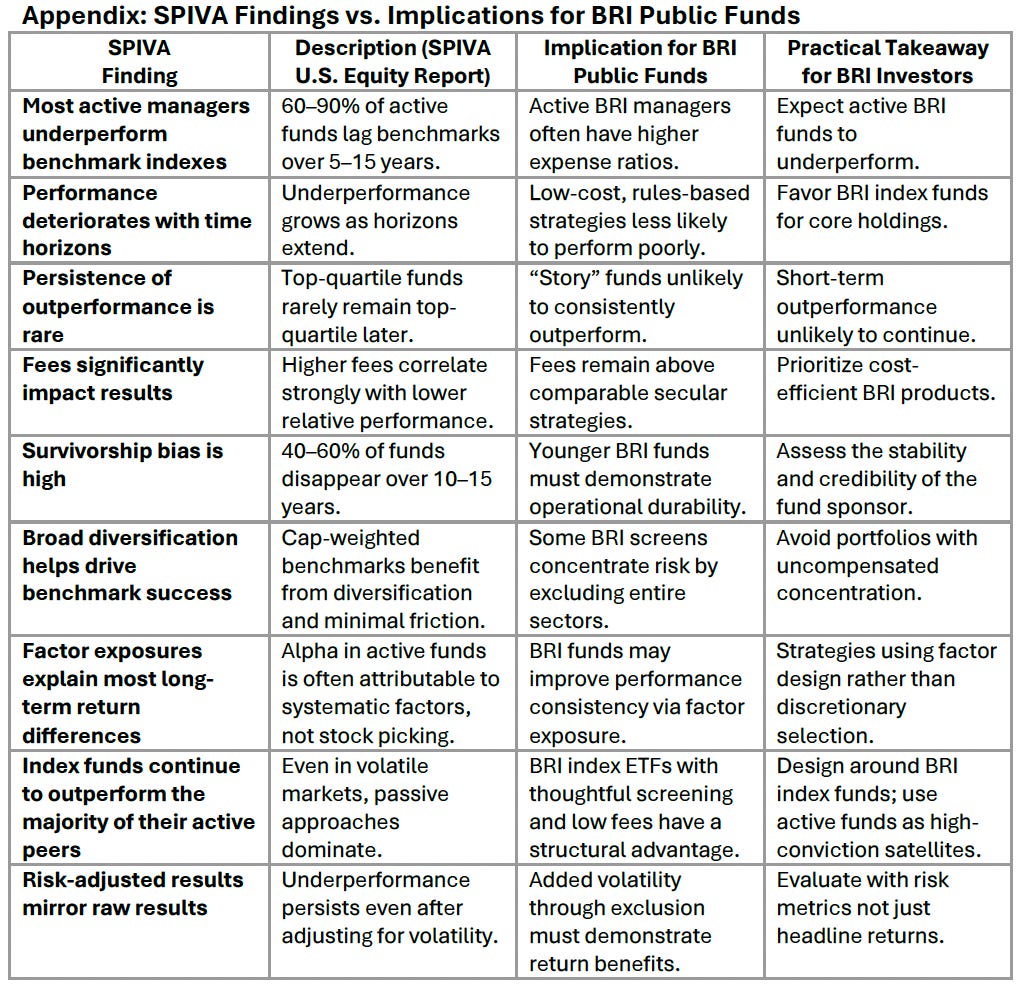
SPIVA reveals that markets are efficient, fees matter, persistence is rare, and systematic design wins over time. BRI funds—like all funds—thrive when they combine biblical conviction with disciplined, evidence-based investment construction.
Jake, Thank you for your encouragement. I am amazed at how few BRI-related professionals have never heard about SPIVA.
Thanks for this objective post. There really is no way around historically the more you move away from the index - whether by values based screening or normal active screening - the (much) greater the odds you will underperform. Doesn't automatically mean you shouldn't screen for values, but you should go into it with eyes wide open.