

Fred Schwed Jr.’s classic book Where Are the Customers’ Yachts? captured one of Wall Street’s most enduring little puzzles: The investment professionals seemed to be doing quite well, but somehow the customers’ yachts were harder to locate.
The modern mutual fund and ETF industry gives us a fresh version of the same question:
Where are the fund shareholders’ yachts?
To be clear, the mutual fund and ETF industry has done enormous good. It has democratized diversification, lowered transaction costs, expanded access to global markets, and made it possible for ordinary investors to own thousands of securities with one click. This is a legitimate financial blessing. We should not sneer at it.
But we should count it. And when we count it, two tables tell a rather revealing story.
The first table provide estimates the profit pool of funds by expense-ratio bucket. The second estimates benchmark-relative performance by the same buckets. Both are rough estimates, not engraved tablets from Mount Index. But they capture a basic industry pattern: investors tend to get their best deal in the lowest-fee funds, while fund companies often make their best money in the highest-fee funds.
That is not a conspiracy. It is arithmetic wearing a sport coat.
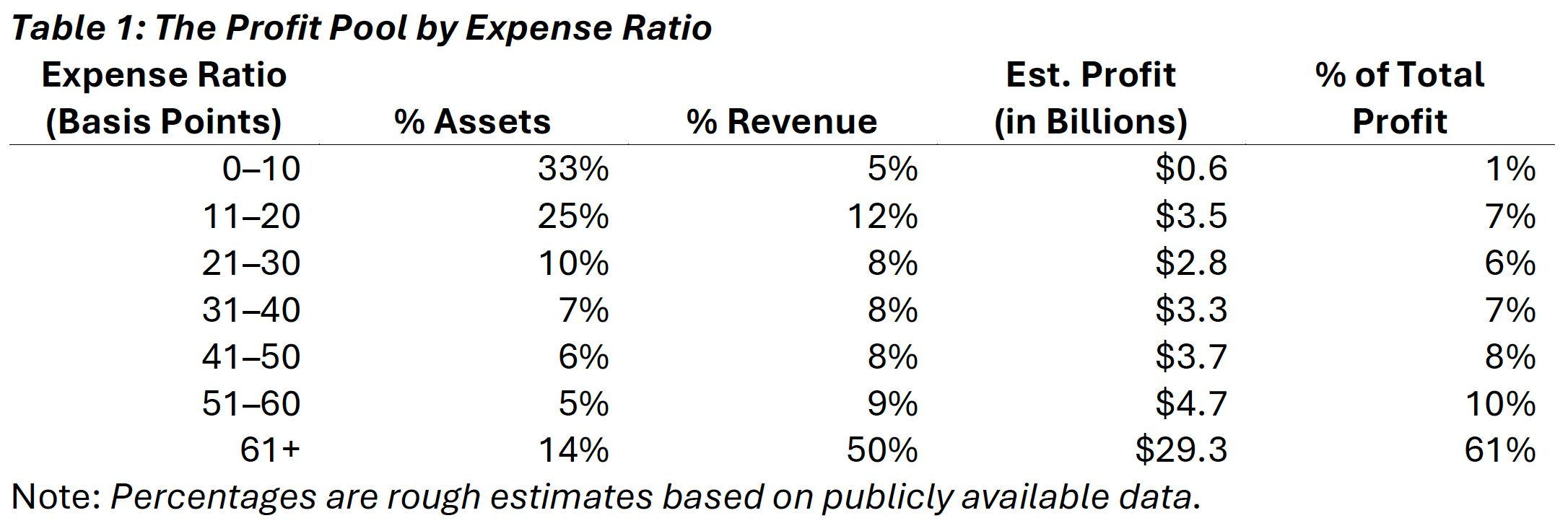
The stunning point is not subtle: the 61+ basis-point bucket may hold only about 14% of assets but generate roughly half of fee revenue and more than 60% of industry profit.
Meanwhile, the 0–10 basis points bucket may hold about one-third of assets but produce only about 1% of total profit.
This is not hard to understand. A 3-basis-point index fund is a wonderful thing for the investor. It is less wonderful for the sponsor unless the fund is enormous. A $10 billion fund charging 0.03% generates only $3 million in gross annual revenue. That sounds like a lot until one remembers that financial firms are not normally staffed by monks who took vows of poverty and PowerPoint.
By contrast, a $10 billion fund charging 0.75% generates $75 million in annual revenue. Same asset base. Twenty-five times the revenue.
The difference between 3 and 75 basis points may look small on a statement. That is why basis points are so useful. They make large things sound like rounding errors. “Only 75 basis points” sounds like the price of adding guacamole. But on a large asset base, those basis points buy yachts.
Or at least very tasteful conference retreats. Now compare that with the rough performance estimate.
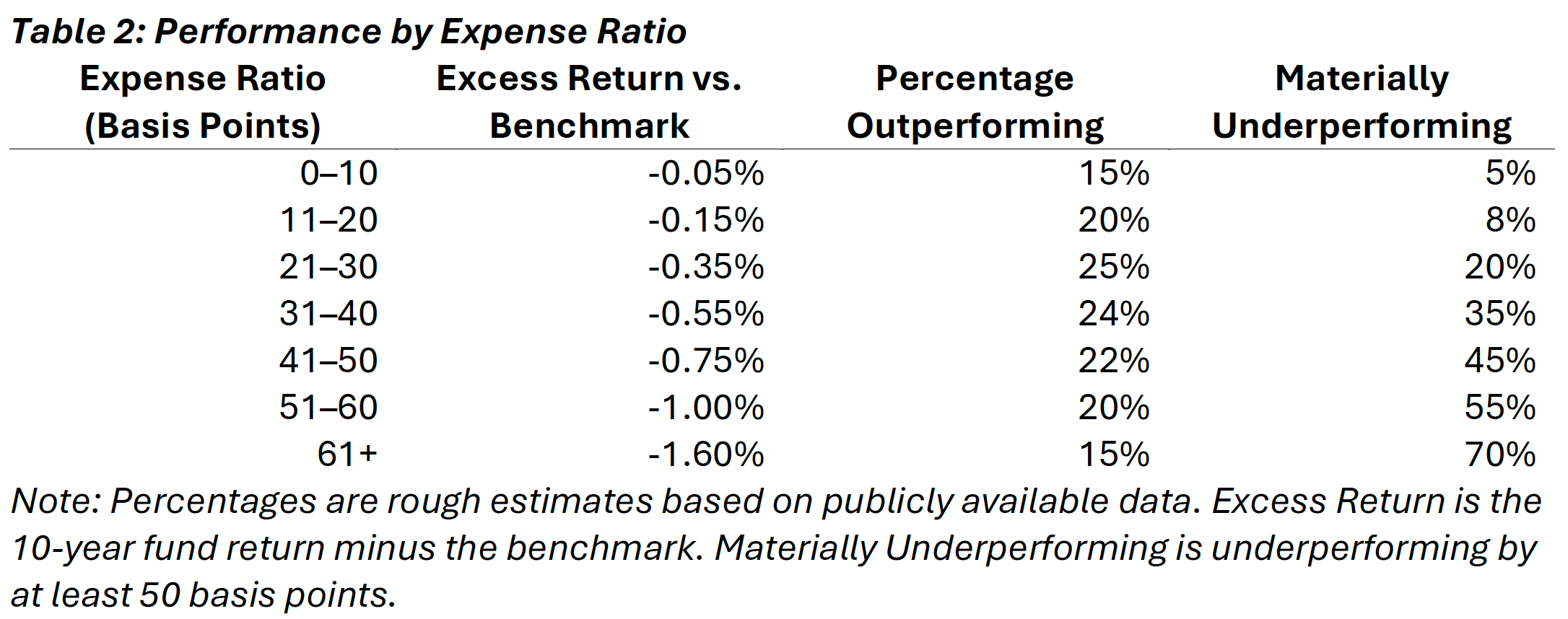
This table should be interpreted carefully. Many ultra-low-fee funds are index funds. Their job is not to beat the benchmark. Their job is to track the benchmark at minimal cost. So it is no insult to say that a 3-basis-point S&P 500 ETF did not “outperform” the S&P 500. It was not trying to perform a magic trick. It was trying to be a mirror—and a very cheap mirror at that.
The real distinction isn’t “outperforming” versus “not outperforming.” The more important question is: How much does the investor lose to costs, complexity, turnover, and manager error?
On that question, the low-fee funds look quite good. They may slightly trail the benchmark, but by very little. Their “underperformance” is mostly the known cost of implementation.
The high-fee bucket is different. These funds are not merely charging more to track. They are generally charging more because they promise—or imply—something better: superior research, superior judgment, superior process, superior access, superior nimbleness, superior adjectives.
Some of them deliver. Many do not.
The rough estimate above suggests that the 61+ basis points bucket may lag category benchmarks by something like 1.6% per year over time, with perhaps 70% materially underperforming by at least 50 basis points per year. That is not a rounding error. That is a quiet compounding leak.
And compounding leaks matter.
A one-year shortfall of 1.6% is annoying. A ten-year shortfall is expensive. A thirty-year shortfall can be the difference between financial flexibility and a retirement plan held together with hope, coupons, and mildly resentful adult children.
The Strange Alignment Problem
Put the two tables side by side and the tension becomes clear:
· The funds that are best for investors are often least profitable for fund sponsors.
· The funds that are most profitable for fund sponsors are often least reliable for investors.
That does not mean high-fee funds are evil. It does not mean low-fee funds are always morally superior. It does not mean every active manager is a villain twirling a mustache in a mahogany-paneled room.
But it does mean incentives matter.
A low-cost index fund says, “We will give you the market return, minus a very small fee.”
A high-cost active fund says, “We will try to beat the market after charging a much larger fee.”
That second promise is not impossible. It is merely difficult. And in a competitive market, difficulty should produce humility. Unfortunately, humility is not always featured prominently in fund marketing materials.
Fund companies are not charities. They have payrolls, compliance departments, technology costs, distribution networks, sales teams, legal bills, and buildings with impressive glass. They must earn revenue. That is not wrong.
But investors must also ask: Revenue for whom? Profit for whom? Performance for whom?
The investor does not benefit from a fund company’s profit margin unless the fund delivers a better net result. A beautiful fund-company income statement is not the same thing as a beautiful investor outcome.
That is the heart of Schwed’s joke. Wall Street often measures success by the prosperity of the providers. The customer should measure success by the prosperity of the customer.
The Christian Investor’s Angle
For Christian investors, this is not merely a technical fee discussion. It is a stewardship discussion.
Fees are not automatically bad. Workers deserve wages. Skill deserves compensation. Good service should be paid for. A planner, advisor, or fund sponsor who provides real value should not be embarrassed to charge for it.
But stewardship requires asking whether the value received is proportionate to the cost paid.
Scripture repeatedly warns against false weights and measures. In the investment world, expense ratios can become a kind of financial weight and measure. They are small numbers with large consequences. They should be clear, fair, and justified.
A Christian approach to investing should therefore be deeply interested in net outcomes. Not stories. Not polish. Not brand aura. Not the quarterly letter written as if the manager just returned from single combat with inflation.
· Net outcomes.
· After expenses.
· After taxes.
· After turnover.
· After survivorship bias.
· After the comforting fog of marketing language has lifted.
So Where Are the Customers’ Yachts?
The customers do have some boats. The rise of low-cost ETFs and index funds has been a major victory for ordinary investors. The industry has become more competitive. Fees have fallen dramatically. Millions of investors now own diversified portfolios at costs that would have seemed almost absurd a generation ago.
That is good news.
But the tables remind us that the old Schwed question is still alive. The biggest profit pool is not necessarily where the best investor outcomes are found. In fact, it may often be located where the odds are hardest for the investor.
So perhaps the updated question is not, “Where are the customers’ yachts?”
Perhaps it is: “Why are the customers still renting kayaks while the fee structure owns a marina?”
The answer is not to hate the industry. The answer is to understand the industry.
For most investors, the starting presumption should be simple: use low-cost, broadly diversified funds unless there is a compelling reason not to. The burden of proof should fall on complexity, not simplicity. The burden of proof should fall on high fees, not low fees. The burden of proof should fall on the claim that a fund can overcome its cost disadvantage—not on the humble little index fund quietly doing its job.
In the end, investors do not need yachts. Most are not asking for yachts.
They are asking for faithfulness, prudence, transparency, and a fair chance to compound capital over time.
That should not be too much to ask. And if the fund sponsor happens to own a yacht, well, congratulations. Just make sure the customer is not the one unknowingly paying for the fuel.
Would a Bear market change this analysis? Also interesting is a slight move up in fees did add outperformance…again, would a bear market increase that?